# Expert Vector Artwork Conversion vs Auto-Tracing: Which Produces Better Results?
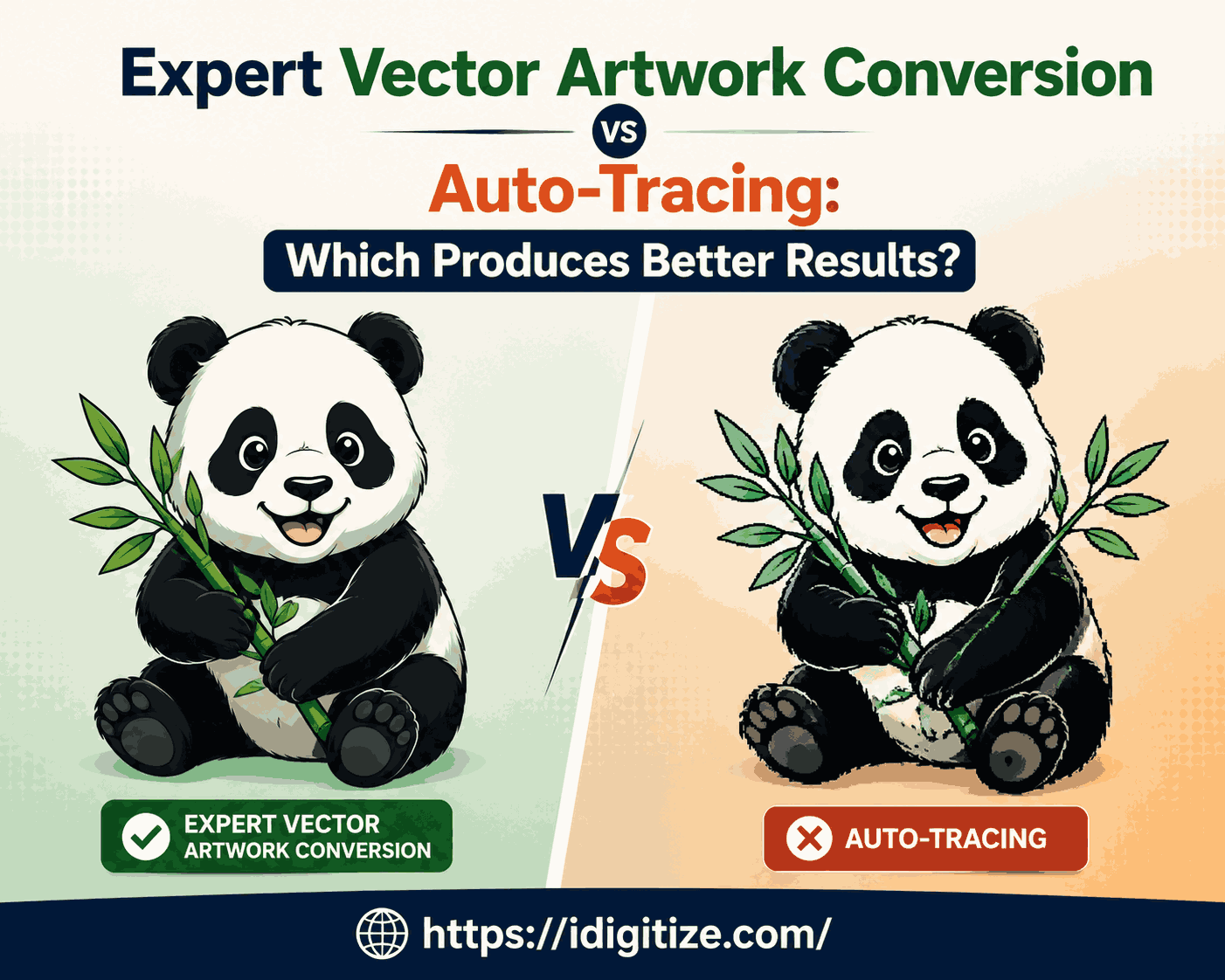
When businesses need a logo, illustration, or graphic converted into a vector file, they often face two options: [expert vector artwork conversion](https://idigitize.com/pages/vector-tracing) or automatic tracing software. While both methods can create vector files, the quality, accuracy, and usability of the final artwork can vary significantly.
For professional printing, embroidery, signage, branding, and promotional products, expert vector artwork conversion typically delivers more reliable and higher-quality results than auto-tracing. Understanding the differences can help businesses avoid costly production issues and achieve better long-term value.
## Main Answer
Expert vector artwork conversion generally produces better results because trained designers manually recreate and refine artwork for accuracy, clean lines, smooth curves, and print-ready quality. Auto-tracing software can be useful for simple projects, but it often creates unnecessary points, rough edges, and inaccuracies that may affect printing, embroidery, and branding consistency.
For businesses that rely on professional-quality graphics, expert conversion usually provides the best balance of accuracy, flexibility, and long-term usability.
## Detailed Explanation
### What Is Expert Vector Artwork Conversion?
Expert vector artwork conversion involves a skilled designer manually recreating artwork using vector paths and shapes. Rather than relying entirely on software automation, the designer carefully adjusts every element to ensure accuracy.
The process often includes:
* Rebuilding logos
* Correcting imperfections
* Matching colors
* Refining typography
* Smoothing curves
* Optimizing artwork for print
The goal is to create a clean, scalable file that accurately represents the original design.
### What Is Auto-Tracing?
Auto-tracing uses software to automatically convert a raster image into vector paths.
Popular design programs offer tracing tools that analyze pixels and generate vector shapes based on the image content.
The advantages include:
* Faster conversion
* Lower initial cost
* Minimal manual effort
However, software cannot always interpret artwork correctly, especially when dealing with low-resolution images, complex designs, or detailed logos.
## How Each Method Works
### Expert Conversion Process
1. Review original artwork
2. Identify problem areas
3. Recreate shapes manually
4. Refine curves and corners
5. Match colors accurately
6. Perform quality checks
7. Deliver print-ready files
### Auto-Tracing Process
1. Upload image
2. Select tracing settings
3. Generate vector paths automatically
4. Export vector file
The speed advantage is clear, but quality often depends heavily on the source image.
## Comparison: Expert Conversion vs Auto-Tracing
| Factor | Expert Vector Artwork Conversion | Auto-Tracing |
| -------------------- | -------------------------------- | ---------------------------- |
| Accuracy | Excellent | Moderate |
| Logo Reproduction | Highly Accurate | May Vary |
| Print Quality | Professional | Can Be Inconsistent |
| Scalability | Excellent | Good |
| File Cleanliness | Very Clean | Often Contains Excess Points |
| Typography Accuracy | Precise | Often Distorted |
| Color Matching | Better Control | Limited Accuracy |
| Production Readiness | High | May Require Editing |
| Time Required | Longer | Faster |
| Initial Cost | Higher | Lower |
## Why Auto-Tracing Often Creates Problems
### Excessive Anchor Points
Auto-tracing software frequently creates hundreds or even thousands of unnecessary anchor points.
This can lead to:
* Larger file sizes
* Slower editing
* Rough curves
* Production complications
### Inaccurate Lettering
Text is one of the most common areas where auto-tracing struggles.
Letters may become:
* Uneven
* Distorted
* Misaligned
* Difficult to edit
For brand logos, even small typography errors can create inconsistencies.
### Poor Curve Quality
Smooth curves are essential for professional printing.
Auto-tracing often generates jagged or irregular curves that become noticeable on:
* Large signs
* Vehicle wraps
* Banners
* Promotional products
## Examples and Practical Use Cases
### Company Logo Recreation
A business only has a small JPG version of its logo from an old website.
Auto-tracing may reproduce the logo, but close inspection often reveals:
* Uneven curves
* Distorted text
* Shape inaccuracies
An expert designer can rebuild the logo accurately, ensuring consistency across all marketing materials.
### Embroidery Digitizing
Embroidery digitizers often prefer professionally converted vector files because they provide cleaner outlines and more accurate shapes.
This can lead to:
* Better stitch paths
* Cleaner embroidery
* Reduced production adjustments
### Large Format Printing
A trade show banner printed at several feet wide will reveal imperfections hidden in small artwork.
Professional vector conversion helps maintain quality at larger sizes.
### Vehicle Graphics
Vehicle wraps require precise artwork to maintain brand consistency across large surfaces. Expert conversion helps ensure every detail remains accurate.
## Step-by-Step Guide: Choosing the Right Option
### Step 1: Assess Your Intended Use
If the artwork will be used for:
* Professional printing
* Embroidery
* Signage
* Branding
expert conversion is usually the safer choice.
### Step 2: Evaluate Artwork Complexity
Simple icons may work with auto-tracing.
Complex logos often require manual recreation.
### Step 3: Consider Long-Term Usage
If the artwork will be reused for years, investing in a professionally created vector file can save time and money later.
### Step 4: Review Quality Requirements
Higher quality expectations generally favor expert conversion.
### Step 5: Compare Total Costs
While auto-tracing may appear cheaper initially, production corrections and rework can increase overall costs.
## Pros and Cons
### Expert Vector Artwork Conversion
#### Pros
* High accuracy
* Clean vector paths
* Better print quality
* Accurate typography
* Improved scalability
* Greater editing flexibility
#### Cons
* Higher upfront cost
* Longer turnaround time
### Auto-Tracing
#### Pros
* Fast conversion
* Lower initial cost
* Suitable for simple artwork
#### Cons
* Inconsistent quality
* Excessive anchor points
* Distorted lettering
* May require manual cleanup
* Less reliable for professional applications
## Common Mistakes to Avoid
### Choosing Auto-Tracing for Important Brand Assets
Businesses sometimes use auto-tracing for logos without realizing the long-term impact on brand consistency.
### Using Low-Resolution Source Files
Poor source images reduce conversion quality regardless of the method used.
### Ignoring Final Application Requirements
Different production methods may require specific levels of artwork precision.
### Not Reviewing Converted Files
Always inspect the final vector file before production.
### Focusing Only on Initial Cost
A cheaper conversion can become more expensive if corrections are needed later.
## Expert Tips
### Save Master Vector Files
Keep original vector files organized for future projects.
### Request Editable Formats
Editable files make future updates easier.
### Use Professional Conversion for Brand Logos
Company logos often represent a long-term investment and deserve the highest level of accuracy.
### Test Artwork Before Large Production Runs
Review proofs whenever possible to identify potential issues early.
### Verify Printing Requirements
Printing specifications vary by provider. Always confirm current requirements with your printer before production.
## Which Option Produces Better Results?
For professional use, expert vector artwork conversion almost always produces better results than auto-tracing. While automatic tools can provide quick solutions for simple graphics, they frequently struggle with accuracy, typography, curves, and overall file quality.
Businesses that depend on consistent branding, professional printing, embroidery, or large-format graphics generally benefit from professionally converted artwork because it reduces production risks and provides a cleaner, more versatile file.
## Conclusion
The choice between expert vector artwork conversion and auto-tracing ultimately depends on your quality requirements, budget, and intended use. Auto-tracing can be useful for basic projects and quick conversions, but it often introduces inaccuracies that become noticeable during printing or production.
For logos, branding materials, embroidery designs, signage, promotional products, and other professional applications, expert vector conversion provides cleaner artwork, better scalability, and more reliable results. Investing in quality vector artwork from the start can help prevent production issues and maintain a consistent professional appearance across all marketing materials.
## FAQs
### 1. Is expert vector artwork conversion better than auto-tracing?
Yes. Expert conversion typically provides greater accuracy, cleaner paths, and better print quality than automatic tracing.
### 2. When is auto-tracing acceptable?
Auto-tracing may work well for simple graphics or internal projects where perfect accuracy is not required.
### 3. Why do printers prefer professionally converted vector files?
Professional vector files are usually cleaner, easier to process, and produce more consistent print results.
### 4. Can auto-traced artwork be corrected later?
Yes, but extensive cleanup may be required, which can increase time and costs.
### 5. Which option is best for logos and branding?
Expert vector artwork conversion is generally the preferred choice for logos and branding because it ensures accuracy and consistency across all applications.